
Rajeshwar Kant Dubey, Research Scholar
De-dollarisation and the Search for Institutional Alternatives
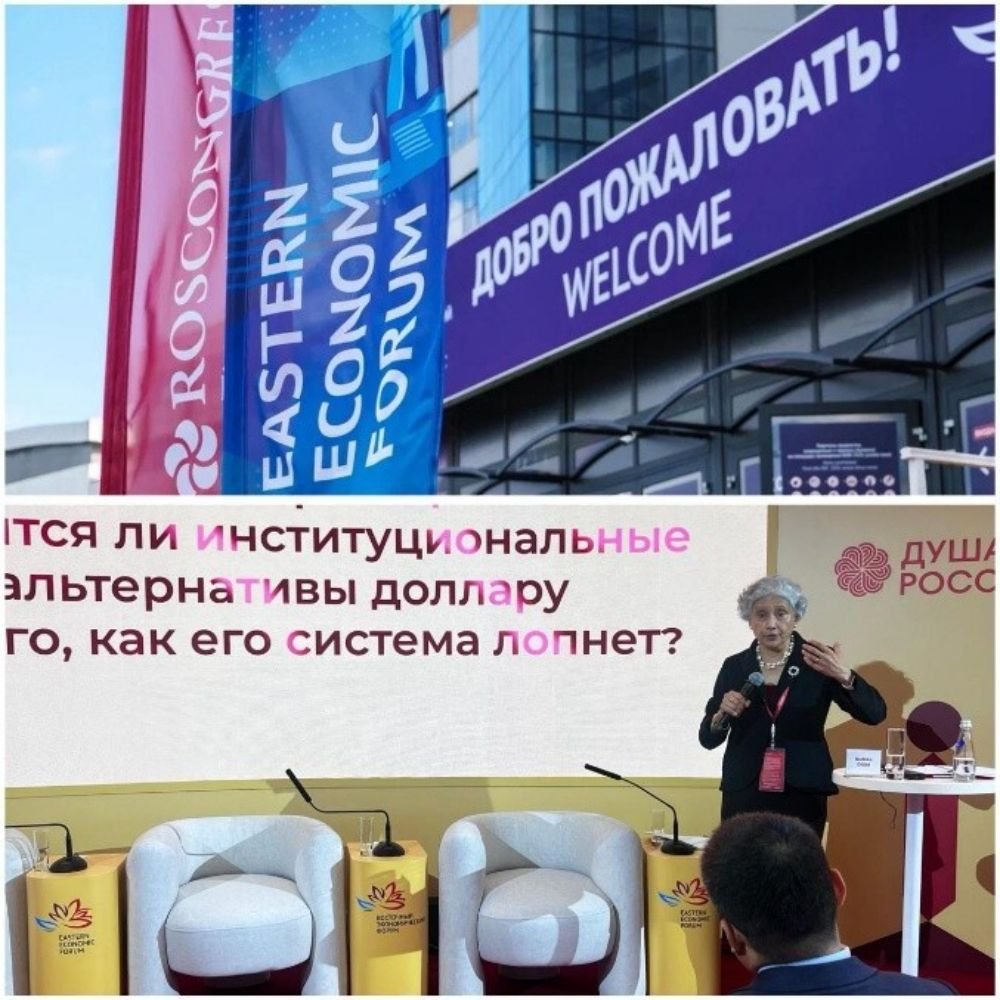
The 11th Eastern Economic Forum (EEF 2026), held in Vladivostok from September 1 to 4, arrives at a moment when the architecture of the global economy is undergoing profound change. Under the theme “The Far East – Development for the Benefit of People,” the forum has brought together governments, businesses, economists and policymakers to discuss not just the development of Russia’s Far East, but the shifting geography of global trade, finance, technology and investment.
Among the most consequential questions surrounding this year’s discussions is one that reaches well beyond Vladivostok: if the world is gradually moving towards de-dollarisation, will institutional alternatives to the dollar-centred financial system actually take shape?
This question carries particular weight because economist and political theorist Radhika Desai is taking part in the EEF discussions alongside economist Michael Hudson. In a discussion ahead of the forum, Desai described their EEF panel as focused on the payment and settlement infrastructure being built outside the Western financial system. She has argued that de-dollarisation should not be understood simply as countries abandoning the US dollar, but as a process involving the emergence of alternative financial arrangements.
Beyond Simply Replacing the Dollar
The debate around de-dollarisation is often framed too narrowly. It is tempting to ask whether the Chinese yuan, the Russian rouble, the Indian rupee or some future BRICS currency can “replace” the dollar. But that may be the wrong question altogether.
The more important question is whether the world can build institutions that make dependence on a single currency and financial system less necessary.
Desai has drawn precisely this distinction. In earlier discussions on alternative financial cooperation, she argued that two processes need to be examined together: the mounting contradictions within the existing dollar system, and the growing availability of alternatives. Yet she has also cautioned that many of these alternatives remain fragmented and ad hoc. A genuinely alternative international monetary arrangement would require countries representing a substantial share of the world economy to agree on a systematic institutional framework.
This is perhaps the central challenge facing the emerging multipolar economy.
It is relatively straightforward for two countries to settle bilateral trade in their national currencies. It is far harder to build the clearing mechanisms, liquidity arrangements, reserve assets, credit institutions, payment networks and legal frameworks needed to support a large international trading system.
That is why the institutional question matters more than the currency question.
Why Vladivostok Matters
EEF 2026 offers an unusually fitting setting for this conversation. Vladivostok sits geographically at the intersection of Russia, China, Northeast Asia and the wider Asia-Pacific, and the forum itself increasingly reflects that orientation.
The 2026 programme features more than 70 sessions across five broad tracks, spanning private investment, international cooperation, technology, logistics and infrastructure. Business dialogues are being held with China, India, the UAE, Mongolia, Vietnam and ASEAN countries.
The forum, then, is not simply about Russia “looking east.” It reflects a larger effort to weave the Russian Far East into economic networks stretching across Asia.
Infrastructure sits at the heart of that effort. Transport corridors, the Northern Sea Route, energy infrastructure, digital technologies, artificial intelligence, investment mechanisms and the development of the Eastern Financial Centre all feature prominently in the programme.
The logic here is straightforward: financial independence cannot exist without productive and logistical independence. A country cannot meaningfully diversify its payment system if its trade still depends on infrastructure, financing and markets controlled elsewhere.
From Payment Systems to a New Financial Architecture
One of the more interesting developments is the emergence of alternative payment infrastructure.
China’s Cross-Border Interbank Payment System (CIPS), for instance, offers an alternative channel for international renminbi transactions. Russia has, in parallel, developed mechanisms to sustain cross-border payments under sanctions. BRICS countries have discussed greater use of national currencies, while digital financial technologies are opening up new possibilities for cross-border settlement.
Academic research increasingly treats these developments as more than political rhetoric. A recent study in the Journal of International Economic Law argues that BRICS states are building legal, technological and institutional mechanisms aimed at reducing exposure to the dollar system, describing de-dollarisation as an emerging institutional project rather than merely a campaign against the dollar.
Yet the obstacles remain considerable.
The dollar continues to benefit from deep and liquid financial markets, established institutions, extensive international usage and powerful network effects. Businesses use the currency because other businesses use it; banks rely on existing payment infrastructure because their partners already operate through it.
Replacing the dollar, then, is not simply a matter of announcing another currency. Any alternative must be trusted, liquid, accessible and institutionally durable.
The BRICS Question
This is where BRICS becomes significant.
The importance of BRICS may not lie in creating a single common currency overnight. Its more immediate value may lie in building multiple layers of financial cooperation: local-currency trade, bilateral currency arrangements, alternative payment systems, development financing, digital settlement and, eventually, more sophisticated clearing mechanisms.
Research on BRICS de-dollarisation has similarly pointed to several possible approaches: new non-dollar financial institutions, alternative financial instruments, local-currency trade and alternative payment infrastructures.
For countries such as India, this approach carries particular relevance. India has a longstanding interest in strategic autonomy and diversified economic relationships. Its engagement with Russia, China, the Gulf, Southeast Asia and the West means New Delhi has little incentive to trade one dependency for another.
The more realistic objective, then, is a diversified monetary system in which several currencies and institutions coexist.
EEF and the Larger Multipolar Transformation
This is what makes EEF 2026 significant beyond Russia’s domestic development agenda.
The forum’s five tracks, spanning life and work in the Far East, private investment, international cooperation, technology and logistics, make clear that the emerging economic order is not being built through monetary policy alone. It is being built through ports, railways, energy corridors, industrial projects, digital networks, financial institutions and trade agreements.
This is why the Far East carries such strategic weight. Russia’s development of the region is, at the same time, an effort to connect its economy more deeply with the fast-growing economies of Asia.
The meeting between Chinese Vice Premier Ding Xuexiang and Russian President Vladimir Putin on the sidelines of EEF 2026, for example, underscored the continuing importance of bilateral development cooperation in Russia’s Far East.
The broader message from Vladivostok, then, is not necessarily that the dollar is about to disappear. Rather, the monopoly of the dollar-centred system is being questioned through the steady construction of alternatives.
Will Institutional Alternatives Emerge?
The answer may ultimately be yes, but gradually.
The most plausible future is not a sudden “de-dollarisation moment” in which the dollar is replaced by the yuan or a BRICS currency. Instead, the world could move towards a plural monetary architecture.
Countries may continue holding dollars even as they conduct a growing share of trade in national currencies. Regional payment systems may expand alongside SWIFT. Development finance may become more diversified. Digital settlement systems may lower transaction costs. Multilateral institutions outside the traditional Western framework may gain greater importance.
Desai’s intervention is valuable precisely because it shifts the conversation from “Which currency replaces the dollar?” to “What institutions can support a genuinely multipolar international economy?”
That, ultimately, is the larger significance of EEF 2026.
Vladivostok is not merely discussing the development of Russia’s eastern territories. It is becoming a meeting point for a wider Asian economic geography, one in which Russia, China, India, the Gulf states and Southeast Asia increasingly interact through multiple channels of trade, investment, infrastructure and finance.
The dollar may well remain the world’s dominant currency for years to come. But dominance and monopoly are not the same thing.
The real transformation may therefore be a quieter one: the gradual construction of institutional alternatives that give states more choices.
And if those alternatives grow sufficiently deep, trusted and interconnected, de-dollarisation will cease to be merely an aspiration or a geopolitical slogan. It will become an institutional reality, built not in a single grand conference, but through the cumulative decisions made in places such as Vladivostok.